Part review
Share the drawing, material grade, dimensions, cutting method and burr photographs. Identify the faces and edges to be processed.

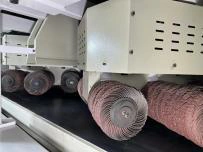 Processing unit shown in this model’s manual page
SSZZ1000VI combines belt removal and edge rounding over 1000 mm working width, with 6 listed rotary-drive motors. Review it when a cleaner face still leaves edges needing hand correction. A vacuum-related unit is listed for the holding assessment. The catalog lists 1–50 mm processing thickness. Allow handling space around the 5143 × 1700 mm machine footprint.
Compare the documented units with your part, edge condition, and required finish.
Compare the same configuration ↗“Not listed” records the contents of the manual, not a confirmation that an option is unavailable. Part suitability and optional equipment are confirmed for the selected configuration.
Values transcribed from the corresponding supplier catalog page. Confirm the ordered configuration and applicable workpiece range before purchase.
| Processing width | 10 mm-1000 mm |
|---|---|
| Processing thickness | 1 mm-50 mm |
| Minimum processing size | 50 mm × 50 mm × 1 mm |
| Abrasive Belt Main Motor*2 | 2x15 kW |
| Conveyor Motor*1 | 4 kW |
| Platform Lifting Motor*1 | 1.1 kW |
| Edge Rounding Lifting Motor*1 | 1.1 kW |
| Edge Rounding Orbital Motor*1 | 1.5 kW |
| Edge Rounding Rotational Motor*6 | 6x3 kW |
| Vacuum adsorption motor*1 | 7.5 kW |
| Total Power | 63.2 kWA vacuum-related motor is listed separately. Confirm whether the quoted total includes that motor and any optional extraction equipment. |
| Pulse Dust Collector | 11 kW/15 kW (optional ) |
| Abrasive Belt Speed | 1450 r/min |
| Chamfering revolution speed(Frequency Adjustable) | 5-12 r/min |
| Abrasive Flap Wheel Speed(Frequency Adjustable) | 300-1450 r/min |
| Conveyor Speed (Frequency Adjustable) | 0.5-7 m/min |
| Adjustment accuracy | 0.02 mm |
| Working pressure | 0.6 MPa |
| Control mode | Manual / Automatic |
| Weight | ≈ 5580 kg |
| Equipment dimensions | 5143 mm × 1700 mm × 2344 mm |
| Abrasive flap wheels | 280 mm × 50 mm × 40 mm × 72P |
| Abrasive belt dimensions | 1010 mm × 2200 mm |
| Conveyor Belt Size | 1000 mm × 9360 mm × 7 mm |
| Main Bearing Model | PA207,FU209,FU210,PH208 |
Adjusting accuracy is a machine-setting parameter. It is not a guaranteed finished-part tolerance or edge radius. Optional extraction and auxiliary units follow the confirmed supply scope.
Compare SSZZ1000VI's listed vacuum-related unit with SSDD1000VI, which does not list one at the same 1000 mm width. Use your part's openings and supported area to assess the holding arrangement; a motor rating does not establish suitability.
| Compare the configuration | SSZZ1000VI | SSDD1000VI |
|---|---|---|
| Working width | 1000 mm | 1000 mm |
| Processing thickness | 1–50 mm | 1–50 mm |
| Listed processing units | 2 listed belt-drive motors; 6 listed rotary-drive motors | 2 listed belt-drive motors; 6 listed rotary-drive motors |
| Vacuum-related unit | Listed | Not listed |
| Machine footprint, length × width | 5143 × 1700 mm | 5143 × 1700 mm |
Share the drawing, material grade, dimensions, cutting method and burr photographs. Identify the faces and edges to be processed.
Compare documented processing units and the working range. Identify the abrasives, support and auxiliary items that require confirmation.
Agree the trial sample, incoming condition and inspection method. Record the setup and the finished edge and surface.
Confirm the selected model, tool sequence, supply scope and acceptance criteria in writing before placing the order.
Request the agreed checks and records for the ordered configuration. Review packing, manuals and destination requirements with SHENGTENG.
Confirm utilities, handling space, extraction interfaces and the available commissioning support for the agreed installation.
Review the combined route when removing a raised burr still leaves an edge your next operation cannot accept. SSZZ1000VI has 1000 mm working width and 6 listed rotary-drive motors after the belt-processing units. Inspect the part after the relevant stages so you can distinguish face removal from edge treatment. A required radius, bevel or protected dimension still needs its own sample criterion.
Compare SSZZ1000VI's listed vacuum-related unit with SSDD1000VI, which does not list one at the same 1000 mm width. Use your part's openings and supported area to assess the holding arrangement; a motor rating does not establish suitability. Both list a 5143 × 1700 mm machine footprint. Include the loading pattern, accessible contours and any manual follow-up in your sample comparison.
Use SSZZ1000VI's own listed dimensions: belt 1010 mm × 2200 mm and abrasive flap wheel 280 mm × 50 mm × 40 mm × 72P. Confirm the wheel construction, arrangement and abrasive specification before ordering, including the meaning of the catalog's P designation. Match grain and grit to your removal and appearance targets. Keep the accepted tool specification with the setup record; matching dimensions alone does not establish the same finish.
No. The SSZZ1000VI catalog lists a vacuum motor of 7.5 kW, but its rating does not specify holding force or validate every perforated shape. Review the supported area, openings, flatness and feed orientation under the proposed abrasive contact. Include your least stable normal component in the trial, and compare accepted output only after you have established repeatable part presentation and accounted for sorting or manual follow-up.
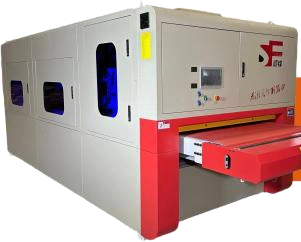
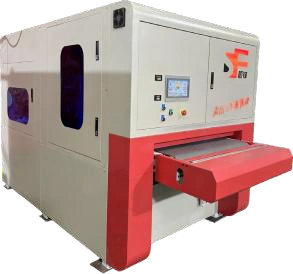
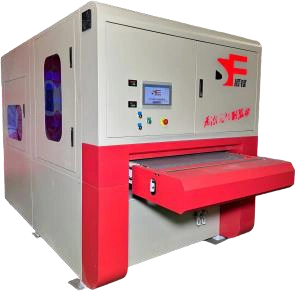
Send the details that matter for a burr removal machine: material, dimensions, burr condition, and the required finish.